Client Integration
With Nextcloud Hub 26 Winter we are introducing a new client integration API. It allows server side apps to expose integrations on Desktop and Mobile. For now we support adding app-defined actions to a “context menu” of files and folders.
It allows providing easy integration of specific actions on clients without the need to write and maintain code on those platforms.
Supported clients
Android: 3.36.0 and above
Desktop: 33.0.0 and above
iOS: 7.3.0 and above
Supported server apps
richdocuments: Convert .docx to .md
assistant: Transcribe audio file
files_zip: Zip a file or folder
contacts: Create new contact from vfc
Exposing actions via capability
Each app can add new actions via capabilities, following the syntax “app-id”, “hook-name” and list of all endpoints.
'client_integration' => [
    Application::APP_ID => [
        'version' => 0.1,
        'context-menu' => [
            // ... endpoints ...
        ]
    ]
]
Hooks
Currently only “context-menu” is supported.
Endpoint
The endpoint tells the client how the menu entry should look like and how the client can send a request to the server.
Requirements:
Every text need to be translated by the app itself.
Current predefined params are
fileIdandfilePath,{fileId}and{filePath}will be replaced by clients with actual values,urlplaceholders are always replaced,mimetype_filtersis a comma-separated list of filters (matches anything that starts with the filter). If there is no filter, the action is shown for every file/folder.All
urlsmust be relative.paramsis used for body params (currently only POST).iconfield should always provide an SVG.methodsupports POST/GET.
[
    'name' => 'translated title',
    'url' => '/ocs/v2.php/apps/abc',
    'method' => 'POST/GET',
    'mimetype_filters' => 'text/, application/pdf', // will match text/* and PDFs
    'params' => ['file_id' => '{fileId}','file_path' => '{filePath}'], // only for POST; the key can vary depending on the app
    'icon' => '/apps/abc/img/app.svg'
],
Responses
When clicking on a menu entry the client sends a predefined request to the server. The app in question can then handle the request and can send two different response types:
Declarative UI response
The declarative UI response allows the app to send back a new UI to be rendered by the client: - version: Indicates which version it is. Clients will be backwards compatible. If server sends a newer version than the client can understand the response will be ignored. - tooltip: Translated text, which will be shown as tooltip / snackbar.
{
  "ocs": {
    "meta": {
      "status": "ok",
      "statuscode": 200,
      "message": "OK"
    },
    "data": {
      "version": 0.1,
      "root": {
        "orientation": "vertical",
        "rows": [
          {
            "children": [
              {
                "element": "URL",
                "text": "Link created",
                "url": "/some/link/to/a/page"
              }
            ]
          }
        ]
      }
    }
  }
}
At the moment only rows with text and url elements are supported, but in the future we will add more elements and options.
Tooltip Response
The tooltip response is a regular DataResponse type, with payload: - version: Indicates which version it is. Clients will be backwards compatible. If server sends a newer version than the client can understand the response will be ignored. - tooltip: Translated text, which will be shown as tooltip / snackbar.
{
  "ocs": {
    "meta": {
      "status": "ok",
      "statuscode": 200,
      "message": "OK"
    },
    "data": {
      "version": "0.1",
      "tooltip": "Task submitted successfully"
    }
  }
}
Example
Here is an example of using the Assistant app.
Capabilities:
ocs/v1.php/cloud/capabilities returns the following capability:
"client_integration": {
  "assistant": {
    "version": 0.1,
    "context-menu": [
      {
        "name": "Summarize using AI",
        "url": "/ocs/v2.php/apps/assistant/api/v1/file-action/{fileId}/core:text2text:summary",
        "method": "POST",
        "mimetype_filters": "text/, application/msword, application/vnd.openxmlformats-officedocument.wordprocessingml.document, application/vnd.oasis.opendocument.text, application/pdf",
        "icon": "/apps/assistant/img/client_integration/summarize.svg"
      },
      {
        "name": "Transcribe audio using AI",
        "url": "/ocs/v2.php/apps/assistant/api/v1/file-action/{fileId}/core:audio2text",
        "method": "POST",
        "mimetype_filters": "audio/",
        "icon": "/apps/assistant/img/client_integration/speech_to_text.svg"
      },
      {
        "name": "Text-To-Speech using AI",
        "url": "/ocs/v2.php/apps/assistant/api/v1/file-action/{fileId}/core:text2speech",
        "method": "POST",
        "mimetype_filters": "text/, application/msword, application/vnd.openxmlformats-officedocument.wordprocessingml.document, application/vnd.oasis.opendocument.text, application/pdf",
        "icon": "/apps/assistant/img/client_integration/text_to_speech.svg"
      }
    ]
  },
},
The Assistant integration has a few endpoints for the client to show and execute. “Summarize using AI” and “Text-To-Speech using AI” appears at the bottom of each menu on the client side:
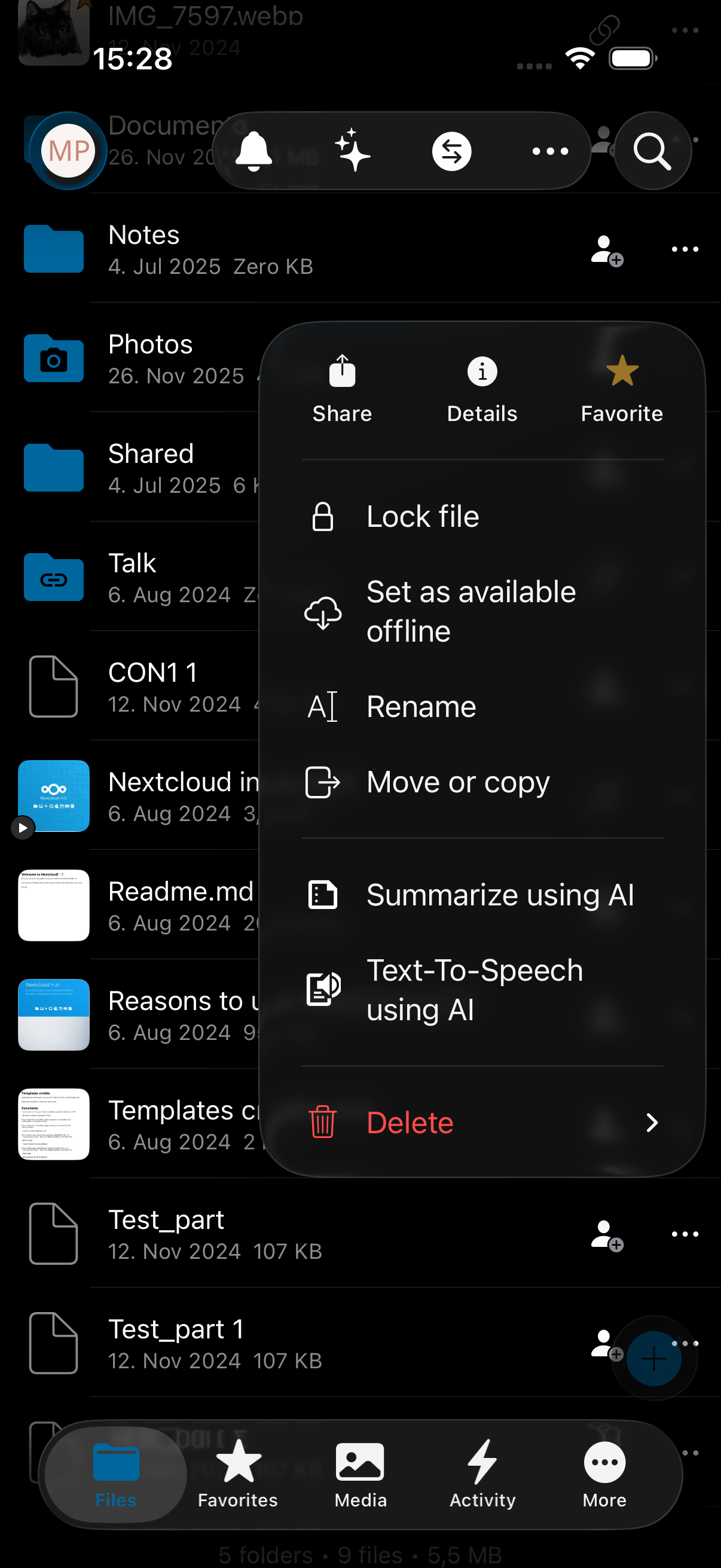
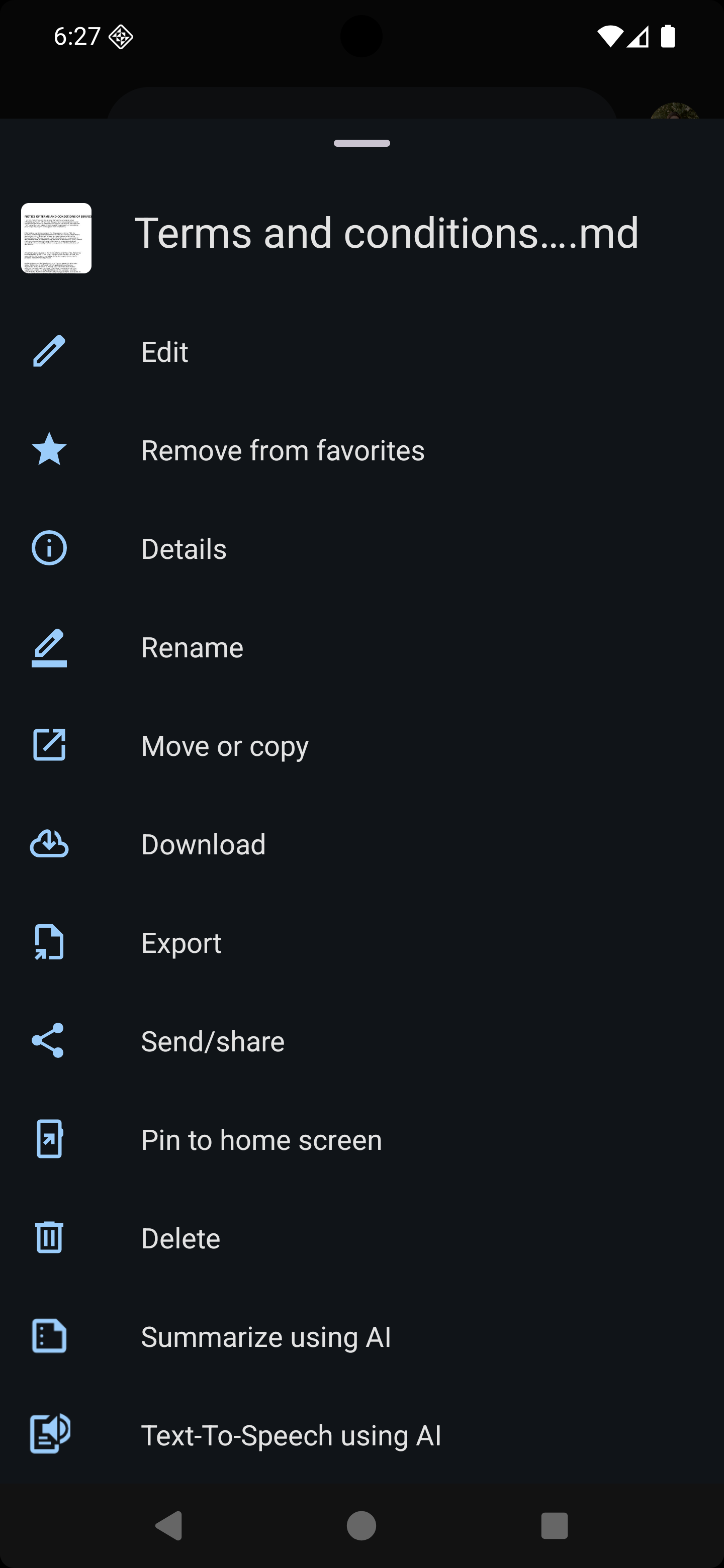
Looking at the “Summarize using AI” action, it will only show for files with mimetypes starting with “text/” or the specified document and PDF mimetypes, as described in mimetype_filters. When clicking on the action, the client will send a POST request to the specified URL, replacing {fileId} with the actual file id. The app can then handle the request and for example send a tooltip response back to the client. The client will show the tooltip to the user:
{
    "ocs": {
        "meta": {
            "status": "ok",
            "statuscode": 200,
            "message": "OK"
        },
        "data": {
            "version": 0.1,
            "tooltip": "Summarization task submitted successfully"
        }
    }
}
Develop your first app with client integration
Familiarize yourself on how to create an app via Develop your first Hello World app for more help on that topic:
Create
Capabilities.phpin/libfolder and add to array ingetCapabilities():
'client_integration' => [
                'pingpong' => [
                    'version' => 0.1,
                    'context-menu' => [
                        [
                            'name' => $this->l10n->t('Ping'),
                            'url' => '/ocs/v2.php/apps/pingpong/ping/{fileId}',
                            'method' => 'GET',
                        ],
                    ],
                ],
            ],
See Endpoint for endpoint details.
Register the app in
lib/AppInfo/Application.php
public function register(IRegistrationContext $context): void {
    $context->registerCapability(Capabilities::class);
}
Add consuming function in
/lib/Controller/ApiController.php:
#[NoAdminRequired]
#[ApiRoute(verb: 'GET', url: '/ping/{fileId}')]
public function ping(int $fileId = 1): DataResponse {
    return new DataResponse(
        ['version' => 0.1,
            'tooltip' => $this->l10n->t("Pong file %s", $fileId)]
    );
}
Response is
DataResponsewith a version (currently 0.1) and a translated tooltip.
Issues/Bugs
Please report issues, bugs or feature requests at https://github.com/nextcloud/files-clients with label “Client integration”.